Key facts
- Tawantinsuyu, the “four parts,” had its capital in Cusco and at its peak stretched from southern Colombia to the Maule River in Chile.
- The great expansion began with Pachacuti, who seized power in 1438 according to the chronicles; radiocarbon dating shows Machu Picchu was already in use around 1420.
- Society was organized in ayllus, with labor in shifts or mita, mutual help or ayni, and records kept on quipus.
- The Qhapaq Ñan, the Inca road network, covers more than 30,000 km and has been a World Heritage Site since 2014.
- Atahualpa was captured in Cajamarca on November 16, 1532, and Inca resistance at Vilcabamba lasted until 1572.
- More than 3.8 million people in Peru learned Quechua as children, according to the 2017 National Census.
In this guide
- What was the Inca Empire, or Tawantinsuyu?
- Timeline: Inca history in key dates
- How was Inca society organized? Ayllu, mita, ayni and quipus
- The Qhapaq Ñan: the Inca road network
- Inca religion and worldview: Inti, Pachamama, the Apus and the three worlds
- Inca architecture: where to see the finest stonework in Cusco
- The arrival of the Spanish and the end of the empire
- Inca culture today: Quechua, festivals, textiles and communities
- Where to see each aspect of Inca culture in Cusco
- Summary: the essentials of Inca history and culture
Inca culture is the culture of the civilization that ruled Tawantinsuyu, the largest empire in pre-Columbian America, from Cusco in the 15th and 16th centuries. Its great expansion began under Pachacuti, who seized power in 1438 according to colonial chronicles, and ended with the Spanish conquest, starting in 1532. In Cusco you can still touch its stone walls, walk its roads and hear Quechua spoken in the street.
Here’s what travelers need to know: where the Incas came from, how they ran their empire, what they believed, how they built, what is still alive today and where to see it in Cusco.
What was the Inca Empire, or Tawantinsuyu?
The Incas called their state Tawantinsuyu, spelled Tahuantinsuyo in Spanish. The National Library of Peru translates it as “four parts”: tawa means “four” and suyu means “part.” According to PromPerú, those four regions were Chinchaysuyo, Antisuyo, Collasuyo and Contisuyo, with Cusco as their political and spiritual center.
At its peak, reached under Huayna Capac, the empire stretched from the Ancasmayo River, in what is now southern Colombia, to the Maule River in Chile, and included part of northwestern Argentina. UNESCO estimates it spanned up to 4,200 km. It brought coastal deserts, snowcapped mountain ranges, valleys and rainforests under a single government.
Cusco was much more than a capital. UNESCO explains that under Pachacuti the city was redesigned as an urban center with clearly defined religious and administrative functions: temples, residences for the royal families and, around them, farming and artisan areas. And it didn’t start from scratch: the valley had been inhabited by pre-Inca peoples for more than 3,000 years.
The origin of the Incas: myth and history
The Incas explained their origin with two myths that are still told in Cusco. In the first, Manco Capac and Mama Ocllo rise from Lake Titicaca, sent by their father the Sun, and found the city where their golden staff sinks into the ground. In the second, the four Ayar brothers emerge from the cave of Tamputoco and reach the valley where Cusco is born.
History is another matter. The Digital Atlas of Peru’s National Geographic Institute places Manco Capac, a legendary figure, around the early 12th century, and describes several centuries of slow expansion around Cusco. The leap came when the Chancas attacked the city and Cusi Yupanqui led its defense and defeated them. He then took power as the ninth Inca under the name Pachacuti, or Pachacutec. The Inka Museum of Cusco’s university presents him as the first historical Inca.
Timeline: Inca history in key dates
Dates before the conquest come from chronicles written after the Spanish arrived, so it’s best to treat them as approximate. One example: radiocarbon analyses published by Yale University researchers show that Machu Picchu was already in use around 1420, at least 20 years earlier than the chronicles suggest.
| Date | What happened | Where to see it today |
|---|---|---|
| More than 3,000 years before the Incas | Pre-Inca cultures settle the Cusco valley; the Wari build centers such as Pikillacta | Inka Museum and Pikillacta |
| Around the 12th century | Manco Capac, a figure between myth and history, settles in Cusco | Origins rooms at the Inka Museum |
| 1438, according to the chronicles | Pachacuti defeats the Chancas, takes power and begins the great expansion | Qorikancha and Sacsayhuamán |
| Around 1420 to 1530 | Machu Picchu is in use, according to radiocarbon dating | Machu Picchu |
| 15th century | Cusco is redesigned as a capital and the Qhapaq Ñan reaches its greatest extent | Historic center of Cusco |
| After Pachacuti | Topa Inca Yupanqui and Huayna Capac extend the empire to Chile and Colombia | Inca roads in the region |
| Before 1532 | Civil war between Huascar and Atahualpa, sons of Huayna Capac | — |
| November 16, 1532 | Francisco Pizarro’s Spaniards capture Atahualpa in Cajamarca | — |
| 1533 | Atahualpa is executed after more than eight months in captivity | — |
| March 23, 1534 | Pizarro carries out the Spanish founding of Cusco | Plaza de Armas |
| May 6, 1536 | Manco Inca rebels and attacks Cusco; fighting reaches Sacsayhuamán in late May | Sacsayhuamán |
| January 1537 | Manco Inca defeats Hernando Pizarro at Ollantaytambo, then withdraws to Vilcabamba | Ollantaytambo |
| 1571 to 1572 | Vilcabamba, the last Inca stronghold, falls, and Tupac Amaru I is captured and executed | — |
| 1911 | Machu Picchu becomes known to the world | Machu Picchu Museum, Casa Concha |
| 1944 | First modern staging of Inti Raymi | Sacsayhuamán, every June 24 |
| 1983 | The City of Cusco and Machu Picchu join the World Heritage List | — |
| June 21, 2014 | The Qhapaq Ñan is declared a World Heritage Site | Sections of the Inca Trail |
How was Inca society organized? Ayllu, mita, ayni and quipus
UNESCO sums up the principles of Tawantinsuyu in three words: reciprocity, redistribution and duality. In practice, communities contributed labor in shifts, and the state built and maintained roads, storehouses and temples. These are the terms you’ll hear most often in Cusco.
The ayllu
According to Peru’s Ministry of Culture, the ayllu was the main form of social organization among Andean peoples before the conquest: a group of families bound by kinship. Similar forms are still alive in parts of Cusco and Apurímac. Today the most widespread form of organization is the peasant community, with an assembly, elected leaders and work days for the common good.
The mita
The word comes from the Quechua mit’a, “turn.” Under the Incas it was the compulsory labor that adult men performed in shifts, from time to time, on public works or on state lands. That is how temples, terraces and roads were built. In the 1570s, Viceroy Toledo turned the mita into a colonial institution aimed mainly at the silver mines of Potosí.
The ayni
Ayni is mutual help between families, repaid with the same help: if I help you in your field today, you help me in mine tomorrow. UNESCO notes that in the communities along the Qhapaq Ñan, life is still defined by kinship ties and an ethic of mutual support. In the villages around Cusco you’ll see it at planting time, at harvest and at festivals, which are organized through reciprocity among relatives and neighbors.
The quipus
The Incas did not use alphabetic writing. They recorded information on quipus, sets of knotted cords. They were used to keep accounts and manage resources, and the specialists who read them were called quipucamayoc. The Incas didn’t invent them: other Andean cultures used them earlier. More than 1,300 survive today in museums and collections, and the non-numerical ones have yet to be deciphered.
Tip: before touring the archaeological sites, spend a morning at the Inka Museum, on Cuesta del Almirante. Seeing the pottery, the stonemasons’ tools, the models of the great sites and the painted qeros there will help you make sense of everything else.
The Qhapaq Ñan: the Inca road network
The Qhapaq Ñan was the system that held the empire together. According to UNESCO, the network covers more than 30,000 km and reached its greatest extent in the 15th century. Four main roads, one toward each suyu, left from Cusco’s central square, today’s Plaza de Armas, and connected with many smaller routes. Messengers, armies, caravans and entire communities traveled along them, and storehouses, lodgings and shrines lined the way.
Inca engineers tackled every kind of terrain with stairways, bridges, retaining walls, drains and paving. Some sections run above 6,600 m. On June 21, 2014, coinciding with the solstice, UNESCO inscribed it as a World Heritage Site following a joint nomination by Argentina, Bolivia, Chile, Colombia, Ecuador and Peru.
From Cusco you can experience the Qhapaq Ñan in several ways. The most famous is the Inca Trail to Machu Picchu. Another, very different one, is the Q’eswachaka bridge, a suspension bridge of plant fiber that four Quechua communities rebuild every year using Inca techniques. In 2013 UNESCO inscribed that renewal as Intangible Cultural Heritage.
Inca religion and worldview: Inti, Pachamama, the Apus and the three worlds
The official religion of Tawantinsuyu revolved around Inti, the Sun, whom the ruler considered his father. Its great temple was the Qorikancha in Cusco. But community religion was broader, and much of it has survived, blended with Catholicism.
- The three worlds: the Ministry of Culture describes a world divided into three planes. Hanan pacha is the world above, of spirits and powerful beings. Kay pacha is this world, of people, plants and animals. Uku pacha is the world below or, more precisely, the world “inside.”
- Pachamama: Mother Earth, responsible for fertility and well-being. She receives the “pago,” an offering that is buried, and the ch’alla, a few drops of a drink poured on the ground before drinking.
- The Apus: the spirits of the mountains, guardians of the land, the people and the livestock. Each community has its own and makes offerings to them.
- Syncretism: after the conquest, Andean cults were banned and replaced with crosses, virgins and saints. Over time a religion emerged that is both Andean and Christian: in some areas, Saint James is associated with Illapa, the thunderbolt, and Pachamama with different images of the Virgin.
The best living example is the pilgrimage to the sanctuary of the Lord of Qoyllurit’i, at Sinakara, at the foot of a snowcapped peak, which UNESCO inscribed as Intangible Cultural Heritage in 2011. It begins 58 days after Easter Sunday and brings together tens of thousands of pilgrims from the communities around Cusco.
Inca architecture: where to see the finest stonework in Cusco
Stonework is the Incas’ signature. UNESCO describes Cusco’s walls as precisely cut blocks of granite or andesite lining straight streets. Look at the joints: the stones fit against each other without mortar. These are the essential places.
Qorikancha
It was the empire’s main temple, dedicated to Inti. Its name means “enclosure of gold,” and Mincetur records that its walls were covered with gold plates. After the conquest it was looted and, in the 16th century, the Convent of Santo Domingo was built on top of its walls. The earthquakes of 1650 and 1950 badly damaged the colonial buildings, while much of the Inca structure held. Today you see both eras side by side. Visit details in our guide to the Qorikancha.
Hatun Rumiyoc and the Twelve-Angled Stone
One block from the Plaza de Armas, the Hatun Rumiyoc passage preserves the wall of Inca Roca’s palace, now the foundation of the Archbishop’s Palace. Set in it is the famous Twelve-Angled Stone, fitted without mortar. It is protected heritage and was damaged in an attack in 2025: look at it and photograph it, but don’t touch it.
Sacsayhuamán
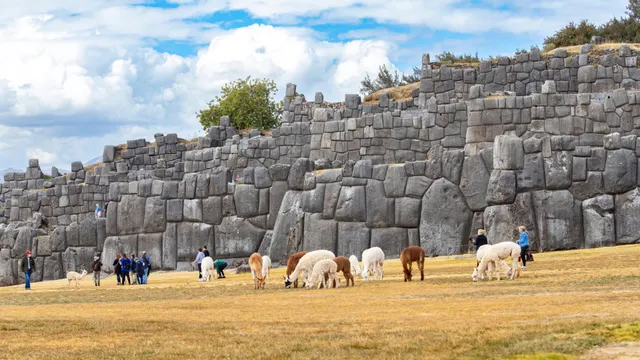
Above the city, construction of this great complex began in the 15th century under Pachacuti and was continued by his successors. Andina estimates that some stones in its walls weigh more than 100 tons. It was the scene of the 1536 battle and today hosts the main ceremony of Inti Raymi. More in our guide to Sacsayhuamán.
Ollantaytambo
Andina calls it the “living Inca city”: a town of Inca origin that is still inhabited, at the foot of an archaeological complex. At the top, the Temple of the Sun has six monoliths of polished stone between 3.32 and 4.20 m tall, brought from the Cachiccata quarry, about 4 km away. It was also the stronghold from which Manco Inca resisted the Spanish. Read our guide to Ollantaytambo.
Machu Picchu
UNESCO calls it the most significant tangible legacy of the Inca civilization. It was built in the 15th century as an estate of Pachacuti, at more than 2,400 m, with about 200 structures divided between a farming area and an urban one. It was abandoned after the conquest and became known to the world in 1911. Everything you need to plan your visit is in our guide to Machu Picchu.
The arrival of the Spanish and the end of the empire
When Francisco Pizarro arrived, the empire was in the middle of a civil war. Huayna Capac had died, and so had his designated successor. Power passed to Huascar, but his brother Atahualpa refused to recognize him. In the midst of that war, on November 16, 1532, Atahualpa was captured by the Spanish in Cajamarca. He offered to fill one room with gold and two with silver in exchange for his freedom, and after more than eight months in captivity he was executed.
On March 23, 1534, Pizarro carried out the Spanish founding of Cusco. The Inca urban layout was kept, but churches, convents and mansions were built on top of it. In 1536 Manco Inca rebelled and attacked Cusco, and fighting broke out at Sacsayhuamán. In 1537 he defeated the Spanish at Ollantaytambo. He then withdrew to Vilcabamba, where the Incas held out until 1572.
The conquest also brought a demographic disaster. The Ministry of Culture estimates that the population of the former empire fell from about ten million people to just one and a half million by the early 18th century, because of wars, displacement and epidemics.
Inca culture today: Quechua, festivals, textiles and communities
The Inca state disappeared, but its culture did not. That is what surprises visitors to Cusco the most.
- Quechua: it was the language of Tawantinsuyu and it is still alive. According to Peru’s 2017 National Census, more than 3.8 million people in Peru learned to speak Quechua as children, and more than 5 million consider themselves part of the Quechua peoples. In Cusco you’ll hear it in the markets and on the street.
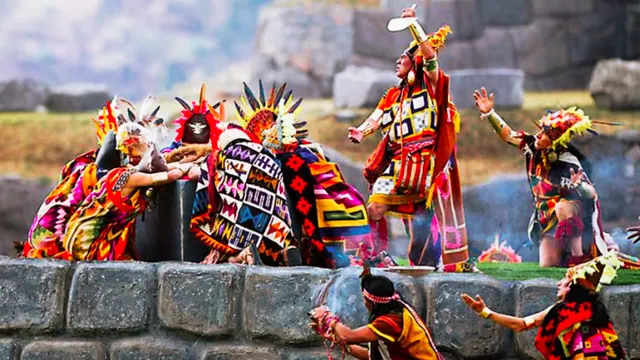
- Festivals: Inti Raymi is held every June 24 at the Qorikancha, the Plaza de Armas and Sacsayhuamán. It recreates the Festival of the Sun that, according to the chronicles, Pachacuti established, and it was first staged in its modern form in 1944. In the communities, festivals for planting, harvest and cleaning the irrigation channels carry on, along with offerings to the earth.
- Textiles: in Tawantinsuyu they were highly prized gifts used to seal alliances. Today they still show which community a person comes from, through designs such as pallay and garments such as the chullo, the chumpi or the llijlla. Many are still woven on backstrap looms. The Center for Traditional Textiles of Cusco, a nonprofit founded in 1996, works with Quechua-speaking weavers to keep these techniques alive.
- Communities: the Quechua peoples have thousands of peasant communities, where collective work, terraces and Andean crops such as potato, oca and quinoa carry on.
Important: many communities welcome visitors, but they are not a stage set. Ask permission before photographing people, especially children and women in traditional dress, and don’t walk into a ceremony without an invitation. If you want to take home a textile, buy it directly from the weavers or their associations.
Where to see each aspect of Inca culture in Cusco
The sites in the center can be seen on foot in one or two days; Ollantaytambo and Machu Picchu require separate trips.
| Aspect | Where to see it | What to look for |
|---|---|---|
| Religion of the Sun | Qorikancha | Inca chambers beneath the colonial convent |
| Fine stonework | Hatun Rumiyoc | Mortarless joints and the Twelve-Angled Stone |
| Monumental architecture | Sacsayhuamán | Walls with blocks of more than 100 tons |
| Living Inca town | Ollantaytambo | A town of Inca origin that is still inhabited |
| Farming and terraces | Machu Picchu and Ollantaytambo | Farming terraces on the slopes |
| Roads and bridges | Inca Trail and Q’eswachaka | Sections of the Qhapaq Ñan and the bridge rebuilt every year |
| Objects and daily life | Inka Museum | Pottery, metalwork, qeros and models |
| Finds from Machu Picchu | Machu Picchu Museum, Casa Concha | Pieces returned by Yale University |
| Festival of the Sun | Inti Raymi, June 24 | Ceremony at Sacsayhuamán |
| Living textiles | Center for Traditional Textiles of Cusco | Backstrap loom weaving |
Two museums to understand the Incas
The Inka Museum, run by the National University of San Antonio Abad in Cusco, is in the Casa del Almirante, at Cuesta del Almirante 103. It covers everything from pre-Inca cultures to the Spanish invasion, with rooms on Inca pottery, architecture, art, metalwork and medicine.
The Machu Picchu Museum, in the Casa Concha, displays objects excavated at Machu Picchu in 1911 and 1912 by Hiram Bingham’s expeditions. Yale University returned more than 46,000 pieces in three shipments, and Peru’s Ministry of Culture declared 4,849 of them National Cultural Heritage. The same Cusco university looks after them.
To fit these visits into your trip, see things to do in Cusco and the Sacred Valley of the Incas.
Summary: the essentials of Inca history and culture
- What it was: Tawantinsuyu, the “four parts,” an empire with its capital in Cusco that at its peak stretched from southern Colombia to central Chile.
- When: the 15th and 16th centuries. The great expansion begins with Pachacuti, in 1438 according to the chronicles, and the empire falls after Atahualpa’s capture in 1532. The resistance at Vilcabamba lasted until 1572.
- How it worked: ayllus bound by kinship, labor in shifts or mita, mutual help or ayni, quipus for record keeping and more than 30,000 km of roads.
- What they believed: in Inti, Pachamama, the Apus and a world of three planes, beliefs that today coexist with Catholicism.
- Where to see it in Cusco: the Qorikancha, Hatun Rumiyoc, Sacsayhuamán, Ollantaytambo, Machu Picchu and the Inka and Machu Picchu museums.
- What is still alive: Quechua, Inti Raymi, Qoyllurit’i, textiles and peasant communities.
Frequently asked questions
What is Tawantinsuyu?
It is the name of the Inca Empire. It translates as “four parts,” after its four regions: Chinchaysuyo, Antisuyo, Collasuyo and Contisuyo, with Cusco at the center.
Who was the most important Inca ruler?
Pachacuti, the ninth Inca. After defeating the Chancas, in 1438 according to the chronicles, he began the empire’s great expansion and redesigned Cusco as its capital.
When did the Inca Empire begin and end?
Its imperial phase spans the 15th and 16th centuries. It began with Pachacuti and fell after the Spanish captured Atahualpa in 1532, although the resistance at Vilcabamba continued until 1572.
What language did the Incas speak?
Quechua, which is still alive. According to the 2017 National Census, more than 3.8 million people in Peru learned it as children.
What gods did the Incas worship?
The official cult centered on Inti, the Sun. Communities also revered Pachamama, Mother Earth, and the Apus, the spirits of the mountains.
How did the Incas build their walls?
With blocks of granite, andesite or other stone carved to fit together without mortar. At Sacsayhuamán some stones weigh more than 100 tons.
Where can you see Inca culture in Cusco?
At the Qorikancha, the Hatun Rumiyoc passage, Sacsayhuamán, the Inka Museum and the Machu Picchu Museum in the Casa Concha. Outside the city, at Ollantaytambo and Machu Picchu.
What is the Qhapaq Ñan?
It is the Inca road network, more than 30,000 km long, which ran from Cusco’s central square toward the four suyus. It has been a World Heritage Site since 2014.
Official sources
- UNESCO: Historic Sanctuary of Machu Picchu whc.unesco.org
- UNESCO: Qhapaq Ñan, Andean Road System whc.unesco.org
- Mincetur: Qoricancha archaeological site record (in Spanish) consultasenlinea.mincetur.gob.pe
- Inka Museum (UNSAAC): Inca origins and continuity (in Spanish) museoinka.unsaac.edu.pe
QorikanchaSacsayhuamánMachu PicchuOllantaytamboQ’eswachaka Bridge
How we put this guide together
Written by Paul Pumalloclla · 17 years in tourism
- Official sources Prices, opening hours and rules checked against Peru’s Ministry of Culture, SERNANP, PromPerú and the train and bus operators.
- Sources cited Every guide links to the sources we used at the end.
- Always up to date When a rule changes, we update the guide and its date.
We’re not a travel agency: we don’t sell tours or take bookings. If a link belongs to a commercial partner, we label it next to the link, and that never changes the facts or the recommendations.
Guide history
- Published
- Last reviewed
Spotted something out of date?
Let us know and we’ll check it against the official source.
Report a change