Key facts
- On a first trip, the historic center near the Plaza de Armas is the most convenient area: almost everything is within walking distance.
- San Blas and San Cristóbal have charm and views, but also steep streets, stairways and lanes taxis can’t enter.
- The Sacred Valley is about 430 to 600 m lower than Cusco (3,399 m): Pisac is at 2,972 m, Urubamba at about 2,870 m and Ollantaytambo at 2,792 m.
- Before booking, ask about heating, hot water, noise, taxi access and luggage storage.
- Hotels range from one to five stars, hostales from one to three, and albergues have no category; classified establishments must display the official plaque.
- June is the busiest month because of the festivities and Inti Raymi on June 24: book months ahead.
In this guide
- What is the best area to stay in Cusco? The answer depends on your trip
- Historic center and Plaza de Armas: everything on foot
- San Blas: the artisans’ quarter, with steep streets
- San Cristóbal and the upper city: views in exchange for stairs
- San Pedro and Santa Ana: Cusco at its most local
- Avenida El Sol, Wanchaq and the airport area
- Cusco or the Sacred Valley: where should you sleep?
- What to check before you book in Cusco
- How to tell whether a place to stay in Cusco is legitimate and safe
- When to book a place to stay in Cusco
- Summary: where to stay in Cusco for your situation
The best area to stay in Cusco on a first trip is the historic center, near the Plaza de Armas: you can walk to almost everything and taxis can drop you close by. San Blas is quieter and has more charm, but it means climbing steep streets and stairs. If you’re worried about the altitude, spend your first nights in the Sacred Valley, about 400 to 600 m lower, and move to the city afterward.
Every season, here in Cusco, we see travelers who pick the right hotel in the wrong neighborhood: a lovely room at the top of a stone stairway they can’t climb with their suitcase, or a hostel next to a street of nightclubs the night before a predawn start. This guide compares neighborhoods, not specific hotels.
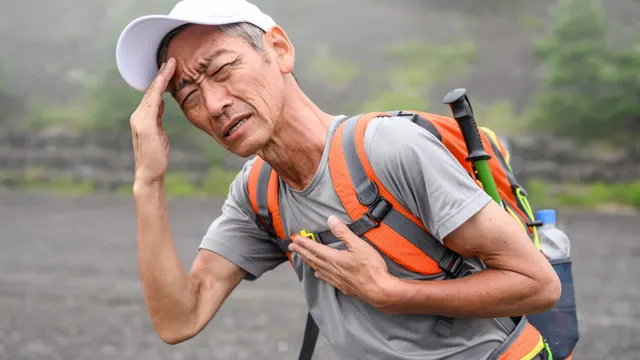
Important: the city of Cusco sits at about 3,399 m, according to PromPerú, and almost everyone arrives by plane from sea level. Choosing where to sleep also means choosing how much you’ll climb on foot every day: the upper neighborhoods, such as San Blas and San Cristóbal, sit above the Plaza. Before you book, read our guide to altitude sickness in Cusco.
What is the best area to stay in Cusco? The answer depends on your trip
No single neighborhood is best for everyone. Decide based on how you travel, how fit you are and what you’ll be doing each day. This table sums up the seven options.
| Area | Pros | Cons | Best for |
|---|---|---|---|
| Historic center and Plaza de Armas | Everything on foot, the widest choice of restaurants and services | Noise from bars and parades; pedestrian streets taxis can’t enter | First trips and short stays |
| San Blas | Charming neighborhood with cafés, workshops and views | Steep streets, stairways and hard access with luggage | Couples and unhurried travelers |
| San Cristóbal and the upper city | Quiet and views over the rooftops | Higher altitude, stairs and an uphill walk back at night | Acclimatized travelers with light luggage |
| San Pedro and Santa Ana | Local feel, the market and simple options | Crowded by day, empty streets at night; Santa Ana is uphill | Tight budgets |
| Avenida El Sol and Wanchaq | Flat streets, taxis to the door, close to the airport | Traffic, less colonial charm and farther from the Plaza | Reduced mobility, families and early flights |
| Sacred Valley | Lower altitude, milder climate, peace and quiet | One to two hours from Cusco; less nightlife | First nights of acclimatization |
| Aguas Calientes | At the foot of Machu Picchu and much lower | Busy town; only for one or two nights | Entering Machu Picchu in the first time slots |
Historic center and Plaza de Armas: everything on foot
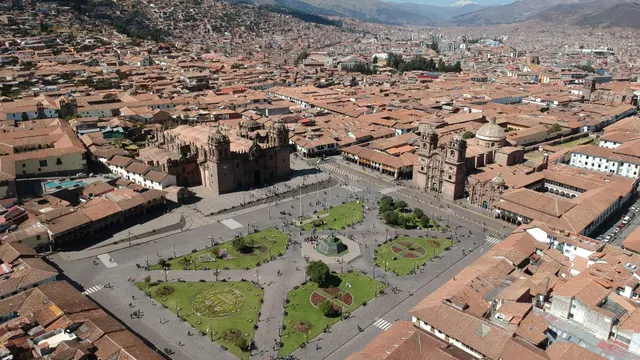
The City of Cusco has been a UNESCO World Heritage Site since 1983. Its center keeps the layout of the Inca capital, with colonial churches and mansions built on top of Inca walls. Staying here puts the Plaza de Armas, the Cathedral, the Qorikancha, the museums and the restaurants a few minutes away. It’s the most convenient option for a first trip of three or four days.
- Pros: you can do almost everything on foot, on streets that are flatter than those in the upper neighborhoods. It’s the liveliest area and has the widest choice of places to stay, from simple hostels to hotels in colonial mansions. Many tours pick up their passengers at or near the Plaza.
- Cons: noise. The streets leading off the Plaza have bars and nightclubs, and in June, Cusco’s anniversary month, there are parades and celebrations almost every day.
- Best for: first trips, short stays and travelers who want to eat out and walk back.
Pedestrian streets, cobblestones and taxis
For years, the Cusco city government has restricted vehicle traffic on several streets around the Plaza de Armas. By 2017, according to Andina, there were already eight pedestrian-only streets, and the mayor described the measure as a UNESCO recommendation for World Heritage cities. In practice, your taxi may drop you at the nearest corner, and you’ll have to walk a block or two over stone with your luggage. Ask your hotel how close a car can get.
In addition, any work on buildings in the region’s historic centers requires a technical inspection by the Decentralized Directorate of Culture of Cusco, part of the Ministry of Culture. That’s why many places to stay in the center are still in old colonial mansions, often with stone stairs and no elevator. If stairs are hard for you, ask for a ground-floor room.
San Blas: the artisans’ quarter, with steep streets
San Blas is about a five-minute walk from the Plaza de Armas, uphill. It’s Cusco’s traditional artisans’ quarter: workshops, galleries, small cafés, a little square with a view over the rooftops and its colonial church. At night it has relaxed bars and live music. More in our guide to the San Blas neighborhood.
- Pros: charm, views and streets that are quieter than those around the Plaza. The center is a short walk away, and you come back to a neighborhood that feels like a village.
- Cons: the slopes are steep, and many streets are stairways or narrow lanes cars can’t enter. With suitcases and the shortness of breath of your first day, the climb is hard. Some bars play music until late.
- Best for: couples, travelers staying more than three days and anyone who has already acclimatized. It’s not the best choice for people with reduced mobility, or for your first night if you arrive with symptoms of soroche.
Tip: if your hotel is on a street with no car access, ask whether someone from the staff can meet you where the taxi drops you off and help with your luggage. Arrive in daylight the first time: the door is much easier to find.
San Cristóbal and the upper city: views in exchange for stairs
Above the Plaza de Armas, on the hillside that climbs toward Sacsayhuamán, is the San Cristóbal neighborhood, with its church and an esplanade that serves as a viewpoint over the city. From the Plaza it’s about a 15-minute walk up steep streets.
- Pros: quiet nights, terraces with views you can’t get in the center, and Sacsayhuamán close by.
- Cons: you sleep higher than the Plaza, and every trip back is uphill, with flights of stairs and poorly lit streets late at night. After dark, the sensible choice is a taxi, which can’t always reach the door.
- Best for: fit, acclimatized travelers with light luggage who value calm over convenience.
San Pedro and Santa Ana: Cusco at its most local
A few minutes’ walk from the Plaza de Armas is the San Pedro Market, the big market in the center, with fresh juices, food stalls and produce from all over the region. Santa Ana lies uphill, above San Pedro, and is a traditional residential neighborhood.
- Pros: a local feel, simple food nearby and modest places to stay. From San Pedro you can walk on the flat to much of the center.
- Cons: by day, the market area is packed, and you should keep an eye on your backpack. At night, once the stalls close, some streets empty out. Santa Ana is also uphill.
- Best for: travelers on a tight budget and anyone looking for a less touristy Cusco. At night, take a taxi back.
Avenida El Sol, Wanchaq and the airport area
Avenida El Sol runs down from the Plaza de Armas, past the Qorikancha and on toward the modern part of the city. It’s wide and flat, lined with banks, offices and all kinds of places to stay. Beyond it is Wanchaq, a residential and commercial district that’s home to Alejandro Velasco Astete International Airport, right inside the city.
- Pros: flat streets, taxis to the door and a quick ride to the airport. It’s the most convenient area for people with reduced mobility, families with strollers or anyone with an early-morning flight.
- Cons: traffic and vehicle noise. It has less colonial charm, and the farther you go into Wanchaq, the more you depend on taxis.
- Best for: reduced mobility, families and a single night between flights. The stretch of the avenue closest to the Plaza is best.
How to get from the airport to your hotel is covered in our guide on how to get from Lima to Cusco.
Cusco or the Sacred Valley: where should you sleep?
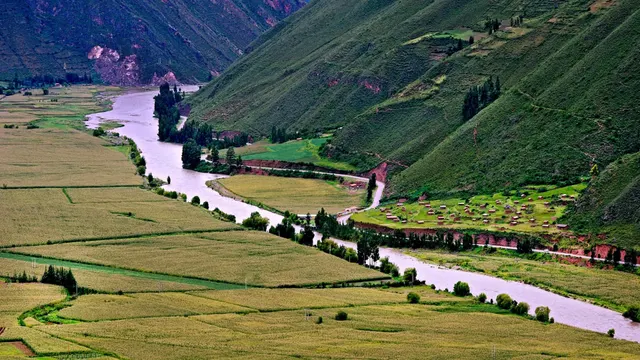
The Sacred Valley of the Incas is lower and milder than the city. That’s why many travelers spend their first one or two nights there and move up to Cusco afterward, as we explain in our altitude sickness guide. The train to Machu Picchu also leaves from Ollantaytambo: you can see the valley, sleep there and continue your trip without going back to the city.
Altitude and distance: Cusco vs. the Sacred Valley
| Place | Altitude | Difference from Cusco | From Cusco |
|---|---|---|---|
| Cusco (city) | 3,399 m | — | — |
| Pisac (town) | 2,972 m | About 430 m lower | About 50 min by car (32 km) |
| Urubamba | About 2,870 m | About 530 m lower | Around 1 h 25 min by car, via Chinchero |
| Ollantaytambo | 2,792 m | About 600 m lower | Around 1 h 45 min by car, via Chinchero |
| Aguas Calientes (Machupicchu Pueblo) | 2,040 m | About 1,360 m lower | No direct road: train from Ollantaytambo, about 2 h |
Altitudes from PromPerú, Mincetur and Andina; travel times from PromPerú, which vary with traffic. For acclimatization, what matters is where you sleep: choose a town on the valley floor, not in the highlands around it.
Urubamba, Ollantaytambo or Pisac
- Urubamba: the largest and most central town in the valley. Many places to stay are outside the town itself, among farm fields, with gardens and plenty of quiet, but you’ll need a taxi for almost everything. Good for resting and for visiting Maras and Moray.
- Ollantaytambo: a compact town with an Inca street plan and the station for trains to Machu Picchu. By day it fills with tour groups visiting the fortress. Ideal if you’re catching an early train. Read our guide to Ollantaytambo.
- Pisac: the closest to Cusco, with its craft market and the archaeological park up on the mountain. A good base for sleeping lower without going too far. More in our guide to Pisac.
Aguas Calientes: one night next to Machu Picchu
The town at the foot of Machu Picchu, officially called Machupicchu Pueblo, isn’t a place to stay for many days. But one night there lets you enter in the first morning time slots or climb Huayna Picchu without an extreme predawn start. When it’s worth it is covered in staying in Aguas Calientes or going back to Cusco the same day?
When sleeping in the valley doesn’t make sense
It doesn’t pay off if you’re doing predawn excursions with pickups in the city, such as Rainbow Mountain, or if you only have two or three days. What works best: land in Cusco, go straight down to the valley for one or two nights, take the train to Machu Picchu and return to Cusco already acclimatized. See examples in our 3-, 5- and 7-day Cusco itinerary.
What to check before you book in Cusco
What makes a place to stay in Cusco good or bad doesn’t always show up in the photos. Before you pay, go through these points and ask in writing about anything that isn’t clear:
- Heating: dry-season nights are freezing, and many houses and budget lodgings have no central heating. Ask whether there’s heating, a space heater or extra blankets. Month-by-month temperatures are in our guide to Cusco weather.
- Hot water: the regulations require even lodgings with no class or category to have hot and cold water 24 hours a day, without the guest having to switch it on. Even so, ask whether the water pressure reaches the upper floors.
- Oxygen: many places have it. It brings relief, but it’s not a treatment: if you have severe symptoms, see a doctor.
- Noise: ask for an interior room if the building faces a street with bars or a busy avenue.
- Real walking distance: check the map not just for the distance, but for the slopes and stairs between your hotel and the Plaza de Armas.
- Car access and elevator: confirm whether a taxi can reach the door and, in old mansions, whether you’ll have to walk up.
- Luggage storage: the regulations require lodgings to offer it. It’s very useful if you go to Machu Picchu and come back: leave your suitcase and travel with a daypack.
- Early breakfast: ask whether they make a to-go breakfast on early-start days.
- Rates and conditions: the establishment must post its rates, check-in and check-out times and the terms of the lodging contract at the front desk and in the rooms. Read the cancellation policy before you pay.
How much to set aside for lodging within your overall trip budget is covered in our guide to the budget for a trip to Cusco and Machu Picchu.
How to tell whether a place to stay in Cusco is legitimate and safe
In Peru, lodging establishments are governed by the Lodging Establishments Regulation (Reglamento de Establecimientos de Hospedaje), approved by Supreme Decree 001-2015-MINCETUR and amended, among others, by Supreme Decrees 005-2021 and 009-2021-MINCETUR. In the region, the competent authority is the Regional Office of Foreign Trade, Tourism and Handicrafts of the Cusco Regional Government, known in other regions as Dircetur.
Official classes and categories
An establishment can apply for a class and, where applicable, a star category. It must meet requirements for infrastructure, equipment, service and staff, and the Regional Office checks them with an on-site inspection.
- Hotel: one to five stars.
- Apart-hotel: three to five stars; made up of apartments.
- Hostal: one to three stars.
- Albergue (hostel): no category; accommodation is mainly in shared rooms.
Only establishments with a valid certificate may advertise a class or stars, and they must display a plaque outside showing the class and category they were granted. At three- to five-star hotels, a safe for valuables, either in the room or a shared safe, is also mandatory.
The National Directory of Qualified Tourism Service Providers
Mincetur, Peru’s Ministry of Foreign Trade and Tourism, publishes a free online directory of classified and/or categorized lodging establishments, with data validated by the regional tourism offices. You can search by RUC (tax ID), company name, location or alphabetical order, and see the address, phone number and website. You can also request the information from Mincetur’s switchboard at (01) 513-6100.
Important: if a place doesn’t appear in the directory, that doesn’t mean it’s illegal. Many legitimate lodgings operate with no class or category, after filing a sworn statement with the regional authority. In that case, check that it has a real street address and a RUC, that it gives you a receipt or invoice (boleta or factura) and that it registers you with your passport on arrival. If someone offers you a room on the street or at the bus terminal, don’t accept without seeing it first.
Guest registration and traveling with minors
To occupy a room, you must sign the guest register with an ID document: keep your passport handy when you arrive. Since 2021, minors are registered too, and they must check in with one or both parents, their guardian or an accredited responsible adult. If you’re a nonresident traveling with your children, the passport or official ID of the child and of the accompanying parents is enough. If the child is with another adult, you’ll also need a document proving the relationship or a written authorization with a notarized signature. More tips in Machu Picchu with kids.
Safety at your hotel and in the neighborhood
- Taxis: book them through an app, by phone or through your hotel, especially at night and in the upper neighborhoods.
- Documents and earthquakes: leave your passport in the safe and, when you arrive, locate the building’s exits.
- iPerú: PromPerú’s free official service answers 24 hours a day at (+51 1) 574-8000 and on WhatsApp at (+51) 944-492-314, and it has an office at Cusco airport. It can also advise you if a service you paid for isn’t delivered as promised.
- Tourist Police: it has a unit in Cusco. Its phone numbers are in our guide is Cusco safe?
When to book a place to stay in Cusco
The dry season, from May to September, brings the most travelers: there’s less availability, and hotel and train prices go up. The peak is June, Cusco’s anniversary month, with Corpus Christi, whose date changes every year, and Inti Raymi, always on June 24. For that week, book months ahead and confirm how to reach your hotel: on the day itself, streets are closed and there are parades in the center.
- June to August: book early, especially in the center and San Blas, and if you need family rooms or ground-floor rooms.
- April, October and November: shoulder months, with good weather and more availability.
- December to March: rainy season, with fewer visitors. Stone streets get slippery in the rain: a flat area is a plus.
Book your Machu Picchu ticket and train first, since they sell out sooner, then fit your nights around the dates you get, using free-cancellation rates.
Summary: where to stay in Cusco for your situation
- First trip: the historic center, a few blocks from the Plaza de Armas, on a street without bars.
- Charm, and steep streets don’t scare you: San Blas, once you’ve acclimatized.
- Views and quiet: San Cristóbal and the upper city, with light luggage.
- Tight budget: San Pedro and Santa Ana, with a taxi at night.
- Reduced mobility, young children or an early flight: Avenida El Sol or Wanchaq.
- Worried about the altitude: one or two nights in Pisac, Urubamba or Ollantaytambo, about 430 to 600 m lower.
- Early entry to Machu Picchu: one night in Aguas Calientes.
- Before you pay: heating, hot water, noise, slopes, taxi access and luggage storage; to check legitimacy, the official plaque, Mincetur’s directory, a RUC and a receipt, and if in doubt, iPerú.
Frequently asked questions
What is the best area to stay in Cusco?
On a first trip, the historic center, a few blocks from the Plaza de Armas and on a street without bars. If you want charm and don’t mind slopes, San Blas; if you have reduced mobility, Avenida El Sol or Wanchaq.
Is it better to stay in Cusco or in the Sacred Valley?
For your first one or two nights, the Sacred Valley, because it’s about 430 to 600 m lower and helps you acclimatize. After that, Cusco, which is the base for almost every excursion and has more services.
What is the altitude of Cusco compared with the Sacred Valley?
The city of Cusco is at about 3,399 m, according to PromPerú. In the valley, Pisac is at 2,972 m, Urubamba at about 2,870 m and Ollantaytambo at 2,792 m; Aguas Calientes is at 2,040 m.
Is San Blas a good place to stay?
Yes, if you’ve already acclimatized and travel light: it’s quiet, with cafés and views, about a five-minute walk from the Plaza. But the slopes and stairways are steep, and many streets have no car access.
Can taxis reach every hotel in the center?
No. Several streets around the Plaza de Armas are pedestrian-only, and San Blas and San Cristóbal have stairways and narrow lanes. Ask your hotel how close a car can get and whether they can help with your luggage.
Where should I stay in Cusco with reduced mobility or young children?
On Avenida El Sol or in Wanchaq, with flat streets and taxis to the door, or in the center in a ground-floor room. Avoid the upper neighborhoods and ask whether there’s an elevator, since many old mansions don’t have one.
Do hotels in Cusco have heating?
Not always: many houses and budget lodgings have no central heating, and dry-season nights are freezing. Before booking, ask whether there’s heating, a space heater or extra blankets.
How can I tell whether a hotel or hostal in Cusco is legitimate?
Look for the official plaque with its class and category on the front of the building and check it in Mincetur’s National Directory of Qualified Tourism Service Providers. If it has no category, make sure it has a RUC (tax ID), a real address and gives you a receipt.
What do hotel stars mean in Peru?
They are granted by the regional tourism authority under the Lodging Establishments Regulation: hotels range from one to five stars, apart-hotels from three to five and hostales from one to three. Albergues have no category.
What documents do hotels ask for if I travel with my children?
For nonresident travelers with their children, the passport or official ID of the child and of the accompanying parents is enough. If the child travels with another adult, a document proving the relationship or an authorization with a notarized signature is also required.
How far in advance should I book a place to stay in Cusco?
From June to August, as early as you can; for Inti Raymi week, months ahead. From December to March, the rainy season, there is usually more availability.
Is it worth staying in Aguas Calientes?
For one night, yes, if you want to enter Machu Picchu in the first time slots or climb Huayna Picchu. It isn’t a place to stay for many days.
Official sources
- Mincetur, Tourism Resources Inventory: Pisaq Archaeological Park (altitude of the town of Pisac) consultasenlinea.mincetur.gob.pe
- PromPerú and Machupicchu District Municipality: Machupicchu Pueblo and its other wonders (altitudes) repositorio.promperu.gob.pe
San Blas NeighborhoodSacred Valley of the IncasOllantaytamboPisacAguas Calientes

How we put this guide together
Written by Paul Pumalloclla · 17 years in tourism
- Official sources Prices, opening hours and rules checked against Peru’s Ministry of Culture, SERNANP, PromPerú and the train and bus operators.
- Sources cited Every guide links to the sources we used at the end.
- Always up to date When a rule changes, we update the guide and its date.
We’re not a travel agency: we don’t sell tours or take bookings. If a link belongs to a commercial partner, we label it next to the link, and that never changes the facts or the recommendations.
Guide history
- Published
- Last reviewed
Spotted something out of date?
Let us know and we’ll check it against the official source.
Report a change